Monday, 7 September 2020

Eel Creek (Star Track)

Eel Creek Station was one of the original stations of the Greymouth to Hokitika railway line. It was located where the Star Track or Stafford Track met the railway line and it provided communication to people from Stafford and Goldsborough using the railway before the current road between Awatuna and Stafford was built. It was about 700 metres south of the station that was to replace it at Awatuna.


The 1939 Map Series NZMS13 - showing the Star Track meeting the railway, the site of Eel Creek station and the replacement station at Awatuna


Before the railway line to Hokitika was officially opened in November 1893 the "station" was called Stafford Track.

West Coast Times, 20 May 1893


It was also the a popular picnic destination with presumably picnicers walking from there to beach at Waimea Creek. 

West Coast Times, 1 December 1894


The West Coast Times of the 13th of January 1984 reported on one of these... 

The Anglican picnic at Eel. Creek , (Stafford track) yesterday was the most successful function of the kind experienced for many years. Tho place is pleasantly situated for a picnic and the youngsters thoroughly enjoyed their ride on the train.- Some hundreds of children and adults went out, and seemed, to be having a good time, ample entertainment being provided for all. Only two casualties are reported. A little boy of Mr J. J. Breeze had a mild attack of sunstroke, and was brought into town,.but is now much bettor, and Master George Mossman some risk of being drowned. Excepting these incidents nothing occurred to mar the complete enjoyment of those present. The Rcvd. Mr Blackburne and the Committee are to be warmly congratulated on the success of their annual gathering.

West Coast Times, 7 July 1894


The Eel Creek station holds the dubious honour of being the first station on the Hokitika line to close. On the 22nd of July 1895 it closed with all traffic using Awatuna instead.


West Coast Times, 20 July 1895


Thursday, 16 June 2016

Lake Mahinapua

On the 9th of January 1906 the West Coast Times carried coverage of the opening of the railway line between Hokitika and Lake Mahinapua on the 8th of January 1906. This first section of the line between Hokitika and Ross also the 5/8 mile long bridge over the Hokitika River 

Advertising the opening in the West Coast Times, 8 January 1906


Opening of the Extension to Lake Mahinapua
Right Hon the Premier performs the Ceremony
Hon Minister of Lands Present
A Large and Imposing Gathering 
Brilliantly Successful Function

The veriest King's weather prevailed yesterday for the ceremony of the opening of the first section of the Hokitika - Ross railway, the elements for once propitious. The joining of the important southern district by a further length of railway made the event of exceptional importance, and the population from north as far as Reefton, from Greymouth, Kumara, and intermediate stations, and from south including Ross and farther South, assembled in vast numbers to do honour to the occasion. It was especially a day for rejoicing, the inauguration of the opening length of the steel band which will eventually bring South Westlanders in the distant South within daily communication with their fellow settlers in the northern part of the County, and as such it. was recognised and celebrated. The Northern train arrived in Hokitika about 1.30 p.m. bringing the Right Hon the Premier, Mrs Seddon, and their party, the Hon T. Y. Duncan, Minister of Lands, Hon A. R. Guinness, M. H. R. Hon James Marshall, M.L.C., the Mayor of Greymouth (James Petrie, Esq), Mayor of Kumara, (J Murdoch, Esq), and an immense gathering from the northern district, the train which was crowded being a very long one.

On arrival at Hokitika the Premier and the Ministerial Party were again met by a great concourse of people, the whole population of Hokitika and the surrounding district turning out for the function. The Volunteer and Citizens Bands were .present and accompanied the excursion to the lake, and here it may be mentioned that Hokitika was en fete for the occasion, the town displaying bunting at all flag poles, while Mr F. King, of the Exchange Hotel, extended an arch of flags in Revell Street from his hotel to the opposite side of the street. 

The reception of the Premier at the Hokitika railway station was informal, and a start was made immediately for the southern excursion to open the line. 

The Route
The route of the line to the Lake is the start of one of the most picturesque journeys in New Zealand. Crossing the Hokitika River by that fine structure, the Hokitika River Railway Bridge, the line continues through an exceedingly pretty piece of bush, crossing Fisherman's Creek and thence Mahinapua Creek at a point near McIntosh's farm. The railway then continues along to. the lake between Mahinapua Creek and the sea until Lake Mahinapua is reached. The whole length completed, is approximately between six and seven miles, or nearly half the distance by rail to Ross, the present intended terminus. The changing views from the dense bush to the seaside, with a glimpse of the beautiful Mahinapua Creek in passing, called forth general admiration from all present yesterday. The Public Works Department had the line in good order, it being permanently laid to within a mile of the Lake Road station, which is the Mahinapua terminus. The following officers of the Public Works Department, which is responsible for the construction of the line, and Railway Department, which will take the line over, were present yesterday, and it was due to their preparation and the care exercised that the excursion passed off so successfully, without a hitch. Messrs Thomson, resident engineer, and McGlashan, assistant engineer Public Works Department, were present, and Messrs Ashley. Traffic Manager, and Widdop, District Railway Engineer, of the Railway Department. 

The Opening Ceremony
On arrival at the Lake Road Station, the people having disembarked from the train and assembled, the ceremony of cutting the ribbons (red, white and blue) which crossed the line, was performed. 

The Mayor of Hokitika (Mr Mandl) in a few appropriate words asked Mrs Seddon to perform this ceremony, and the Premier to declare the line open. The Camera Fiends were very much in evidence, and secured many pictures which will ultimately possess historic value. The photographs having been taken the party then proceeded a short distance to the left of the line, where a solid platform of silver pine sleepers had been erected, and from there the addresses were given. 

Declaring The Line Open 
The Mayor of Hokitika said the pleasantest duty he had to perform that day took them back many years to the opening of the Grey-Hoka railway, but there was a difference that the Hoka-Grey line took fourteen years to finish. The then Government kept £100,000 lying dormant on that line for about ten years, but that was in the time of the stagnation Government. That Government would neither allow them to finish the line themselves nor would they finish it. If the Liberal Government had not got into power, they would not, he believed, have got the Hoka-Grey line finished now. (Applause.) When Mr Seddon got in first he said he would have the Hoka-Grey line finished or burst. (Laughter and applause) He had finished the line as he said he would. (Applause) The speaker referred to the splendid prospects the Hoka-Ross line had of paying of which they had plenty of evidence. Despite the drawbacks in the construction of the Grey-Hokitika line, and the fact that they had been told it would not pay for grease for the wheels, it had proved one of the best paying lines, in the colony, (applause) and he confidently predicted that the extension of that line to Ross would prove equally payable (Appluase). He called on Mr Bruce, Mayor of Ross to address them. 

Mr Bruce said it was a source of the utmost satisfaction to him as it was to all present, to have the first half of the line opened on the present occasion. The Government bad been twitted by the Opposition to their extra large expenditure in the Premier's constituency, but what were the facts? Out of the 2374 miles of railway made in the colony, there were only 21 miles constructed in Westland. (applause). He thanked the Government for what they had done for the people of Westland in the construction, but they had not done half enough. (Laughter and applause). The first sod of the line had been turned on February 6th 1902 and the Premier had promised they should have the line completed to Ross in two years (applause). That was nearly four years ago, and be hoped the progress of the rest of the line would not be at the same pace (applause). He drew attention to the fact that the contract time for the Totara bridges, was thirteen months, and thought that that time was much too long. He concluded by hoping that within a year from the present time, the line would be opened at Ross, (applause). 


Mr McGuigan, County Chairman of Westland, was gratified to see such a large gathering, and especially for the cause of it. There was not a greater coloniser in any country than railway construction, and the Hokitika-Grey railway furnished a notable instance of that fact He fully agreed with all that had been said as to the necessity of pushing on the construction of the line to Ross, and hoped it would not be long before they had the Premier with them again to perform the function (Applause)

Mr Murdoch, Mayor of Kumara heartily endorsed the remarks of the previous speakers, and especially agreed with Mr Bruce that the line should be made to Ross within 12 months. He congratulated the people of the district on the establishment of this connecting link between north and south, and hoped it would not be many years before it was extended to Otago, (Applause). He was pleased to see railway construction going ahead on the Coast, as when their electric line was established to Kumara, it would also bring them into still closer touch with the south (Applause).

The Major of Hokitika (Mr Mandl) here asked leave to refer to something which he had forgotten and wished to ask the Premier for information as to when the contract would be let for the summit tunnel on the Midland railway. As they were extending communication southwards it was equally necessary that they should be establishing their connection with Canterbury. (Applause). 

The Premier’s Speech. 
The Right Hon the Premier said this day was indeed one ever to be remembered with pleasure and would be looked on as one of the first steps in the development of the valuable resources of South Westland. (Applause). In 1870 the Vogel Public Works policy was inaugurated and in the year 1878 the first sod on the Hokitika Grey railway was turned. They would remember how for years afterwards the rails rusted and the sleepers rotted, but he would not enlarge on the injustices down by anyone in the past as he did not desire to put blame on anyone on such an auspicious occasion. What they had to do was to see that there should be no injustices to anyone in the future. It was quite true that out of nearly 3,000 miles of line in the colony there were about 21 miles in the Westland constituency. They had to have roads to make the country habitable, but, as a matter of fact, Westland and the West Coast were for years making up for the losses being made by railways all over the colony (Applause). He referred to the great advantage the Hokitika-Grey line had afforded in developing the district and said he had never been one to agree with those who said that if they had shipping connection it was all that was necessary. The immense crowd who had travelled to the opening of the line that day showed the benefit railway communication had been. The Premier here read a telegram of congratulation to the people of Westland on the opening of the line from Sir Joseph Ward (Applause). He expressed regret at the unavoidable absence of the Minister of Public Works, Hon Hall-Jones, who, though absent in body was present in spirit. (Applause). He introduced the Hon T. Y. Duncan; Minister of Lands, who got a highly popular reception. Mt Seddon, continuing said he would hark back to the Hokitika River bridge, when he said he hoped he would be present at the opening of the line. Well, he was there to open it that day and they had got it half through, and he hoped with health and strength to be there when it was finished and that Mr Bruce (Mayor of Ross) would also be present oh that occasion. Mr Bruce bad expressed impatience that the line was not now finished to Ross, but the Minister of Public Works and the Public Works Department had done really well for them. However, he knew that Mr Bruce’s remarks were not intended as a reproach to the Department, but rather as an answer to those who said Westland got more than its share of public expenditure. (Applause.) Mr Bruce had referred to the great value of the country of South Westland, and the speaker enlarged on the splendid prospects before South Westland in the timber, flax, and mineral industries, coal, gold, silver, and other valuable minerals which would yet be of enormous value to the colony. The railway would yet serve a vast population residing between the Hokitika River and Jackson's Bay. (Applause.) The Premier here made a statement showing the length of line finished, cost of construction, etc as follows:— 

Authorised 1901 : Length, 15 miles. Length by road Hokitika to Ross, 22 miles. Bridge over Hokitika River for railway and road traffic, cost £30,636, and was completed 26th October 1904. Length, 2,800 feet, constructed of iron bark timber and steel girders. 
Portion about to be opened to Lake Mahinapua, about six miles, with two bridges over Fishermen's Creek and Mahinapua Creek costing £1,749, completed 21st September, 1905. 

Thomas Dillon, of Greymouth was the contractor for three bridges. Tenders are invited for the following bridges: Rocky Greek, Camp Creek, Teal Creek, Granity Creek, Cockabully Creek, and Totara River. Tenders close on the 31st January, 1906. Cost of these bridges estimated at £9000. 

Seven bridges will have to be built on this portion, the largest being over the Totara River, for which tenders are due on the 31st January. 

Formation works are in progress six miles further on, and 117 men employed. 

Expenditure to the 31st December was £61,837, and the vote for the current year ending 31st March is £20,000, and the engineer's instructions are to see that this expended by the 31st March. 

The sum of £7000 is available for expenditure to 31st March next. 

Total cost   £61,837 
Bridges          £32,425 
Formation, etc. £29,412 


Continuing, Mr Seddon referred to , the mention Mr Bruce had made as to the contract time for the Totara bridges, and said the time stated, 13 months, was much too long, and he would that day telegraph to the Minister of Public Works to have it shortened. (Applanse.) He was going to refute a charge made by the Opposition before the elections that more monies were appropriated and spent in Westland than in Canterbury. He would show them from a table he had bad compiled that the percentage of monies appropriated but not spent in Westland was not more but less than in Canterbury. The figures quoted were as follows : — 

Ross Hokitika Railway. 
Year. Appropriation. Expended. 
                                      £                      £
1901-02 2,000                   350 
1902-03 10,000                 7,245 
1003-04 10,000 25,063 
1904-05 15,000 17,174 

Total Vote to March 31 last     £37,000 
Total expenditure                    49,837 
For 1905 06                20,000              13,000 
Unexpended 7,000 


As regards the profitable nature of the line they were opening that day, the vast crowd present was the fullest guarantee of it. He did not see as large crowds present at railways be had opened on the other side of the ranges, and although the public were very enthusiastic in Otago when be opened the Lawrence-Roxburgh line the other day, there was not the vast crowd around him that was present that day. There was nothing further for him to say, but to declare the line duly open between Hokitika and Mahinapua. He had been told it would be impossible to have the line open for the present summer tourist season, but he had declared that nothing was impossible, and he was there to open it. (Applause) Referring to the scenery surrounding them, he said he would telegraph to Sir Joseph Ward, asking him to send Mr Donne down at once, as the scene treasures which they possessed were not being made the most of (Applause). He was going South on Thursday and would see the country for himself. What they wanted was to have the Wanganui and Wataroa rivers bridged. He was glad to be able to open the railway that day and gave them all an invitation to be present at the opening of the completed section to Ross. The Premier concluded amidst continued applause. 


Cheers were here given for the Premier, Mrs Seddon, the Hons Sir Joseph Ward, Hall-Jones, T. Y. Duncan, and the Liberal Government as a whole, at the call of the Mayor, and at the invitation, of the Premier, for the Mayors of Hokitika, Ross, Kumara, Greymouth, and the County Chairman. 


The Hon the Minister of Lands being invited to address them, expressed the pleasure it gave him to be present that day. He had often heard of the intelligence of the West Coast people, but he did not need to be told that as from the earliest days they had selected in the Premier the best and most able representative south of the line. (Applause) This was the first time he had got to Westland, and now he had come there he said it would repay anyone to come to see the magnificent scenery through which they had passed. lf there were no more possibilities than what he saw from the top of the range, it was worth putting the "Hole in the Hill" in. (Applause). He advised everyone to as soon as they could seize a piece of land, as when that "hole in the hill" was put through, there would be a rush for their cultivable land such as was experienced in the early days of the Coast. He intended to have a look over the district and see for himself its possibilities, as in view of the demand there would be for land it was necessary to prepare what remained for selection. The Minister heartily congratulated this district on the opening of the line which, from what he had heard that day, he was convinced would greatly enhance the splendid possibilities of their very valuable country (Applause).

The Hon Jas Holmes said he was very happy to see such a large lot of people present, he believed one of the largest gatherings ever held in Westland. He referred to the Hoka-Grey railway of which he saw the turning of the first sod, and believed the sleepers and culverts had to be renewed three times. Referring to the Premier it was impossible for them to get a better representative, and it was due to his unwearying efforts that they had such an advantage as the opening of the line that day would give them. (Applause) 

The Hon Mr Guinness expressed his gratification at being present to witness the ceremony, and to show that his constituents were in sympathy, in accord and in full approbation of the extension as far south of this line as possible, it was only necessary for him to mention that 1200 of the Grey people were present that day, and now he saw another train arriving as the first could not bring them all. (Applause) He referred to the splendid prospects the West Coast length of railway lines had of paying by reason of the timber, flax and coal, and said the construction of a harbour at Point Elizabeth would be the crowning point to make all their lines profitable. He congratulated the people of Westland on the consummation of their hopes and wishes with regard to the Hoka-Ross railway a line which when finished would be of invaluable service to the district. (Applause) 

The Luncheon
The Ministerial Party then adjourned for luncheon to tables set out near the line, numbers of the visitors also joining them. Most of the people present, however adjourned to retreats in the neighbourhood and opened their own picnic hampers, an exceedingly pleasant afternoon being spent. 

At the lunch the Premier's health was toasted by the Mayor of Hokitika, and was drunk with musical honours, Mr Seddon briefly replying. Afterwards many of the party took a stroll through to the lake, which is about a mile distant from the railway through a very pleasant glade. 

Shortly after 5 p m., the first train returned home, the second reaching Hokitika soon after 6 o'clock, and at 7 o'clock the northern visitors left for home well pleased with their day's outing, a day which will be remembered as a red letter day in Westland for many years to come. 


The arrival of the train from Hokitika at Lake Mahinapua and the Premier on 8 January 1906


While goods trains were running to Ruatapu from September 1906 regular passenger traffic on the line began on the 10th of November, 1906. 


West Coast Times, 14 September 1906


West Coast Times, 9 November 1906

Lake Mahinapua station had a loop siding capable of holding 28 x 4-wheel wagons. It's main traffic, however was picnic traffic and for this an 80 foot long station with brick chimneys and all other conveniences, was built along with a long platform.


Excursion trains to Lake Mahinapua for King's Birthday.
West Coast Times, 8 November 1906

The West Coast Times of the 3rd of February 1908 reported on the Greymouth Railway and Foundry picnic. Saturday was an ideal day for picnicers and Lake Mahinapua, as all are aware, affords the most delightful picnic grounds. It goes without saying, therefore, that the annual combined excursion of the Greymouth Railway and Foundry employees held there on Saturday, was a pronounced success. The special train bringing the excursionists to the number of about 2,000, arrived at the Lake shortly before noon, and a very pleasant day was spent sports of all kinds being indulged in. The Greymouth Battalion Band accompanied the picnicers, and greatly enlivened the proceedings.

By mid-1909 the Tourist Department had completed the erection of seats at intervals on each side of the avenue leading from Lake Mahinapua railway station to the Lake. The Department also made improvements to the tourist cottage at the Lake including a verandah and renovated interior.


West Coast Times, 24 December 1910


A picnic party at Lake Mahinapua station in 1925. I would imagine that what can be seen is only half the station, the rest being to the left.


Until 1930 there was no road access to Lake Mahinapua with the Grey River Argus reporting on the 23rd of March 1950 that recently a new road via Ruatapu to Mahinapua Station was completed, giving access by motor. To travel from Hokitika to the lake would entail driving south on the old State Highway via Kaniere and Rimu to Ruatapu and thence north up to the Lake Mahinapua railway station. With the number of picnic passengers to the lake the Grey River Argus reported on the 17th of December 1930 that The Railway Department is about to erect a shelter for boiling water near Mahinapua Station

On the 23rd of March 1950 the Greymouth Evening Star reported that the Hokitika Progress League had decided to make representation to the district engineer to repair and paint the railway station at Mahinapua as the condition of the building “was a disgrace.” The Greymouth Evening Star later reported on the 31st of August 1950 that the Hokitika Progress League were unhappy with a letter from the Resident Engineer of New Zealand Railways in connection, with repairs to Lake Mahinapua Station as evasive and unsatisfactory. It was decided to take the matter up again and if the result was not more satisfactory to go further with the request. 

On the 26th of July 1959 a fire in the Lake Mahinapua station building led to its being replaced by a new shelter. 

Lake Mahinapua was closed for goods traffic on the 20th of February 1961 and presumably this is when the loop was removed.

Picnic excursion trains were the feature of Lake Mahinapua station's history with regular "picnic season" excursion trains being run to Lake Mahinapua during the summer months. The Vol 3, No 10 of The Express reported of the 1966 Runanga Mines picnic. The Runanga Mines picnic train ran from Dunollie to Ross recently.  The picnic was held at Lake Mahinapua and the train was 14-total.  Ab 610 was used on the outward journey and Ab 755 on the return.  After the running of the children's races the men at such picnics invariably retired to the Lake Mahinapua Hotel, opposite the station, to await the the return service.


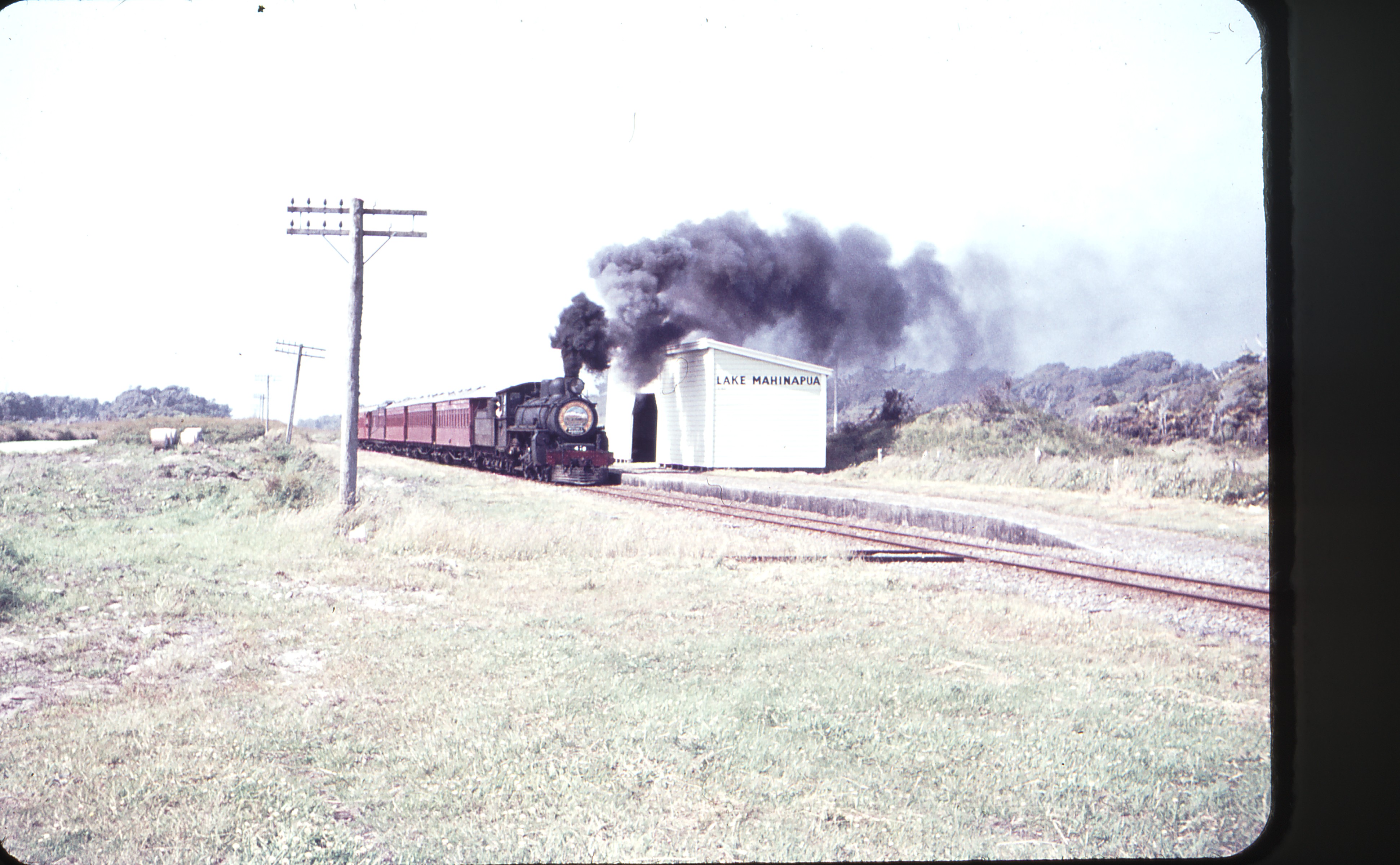
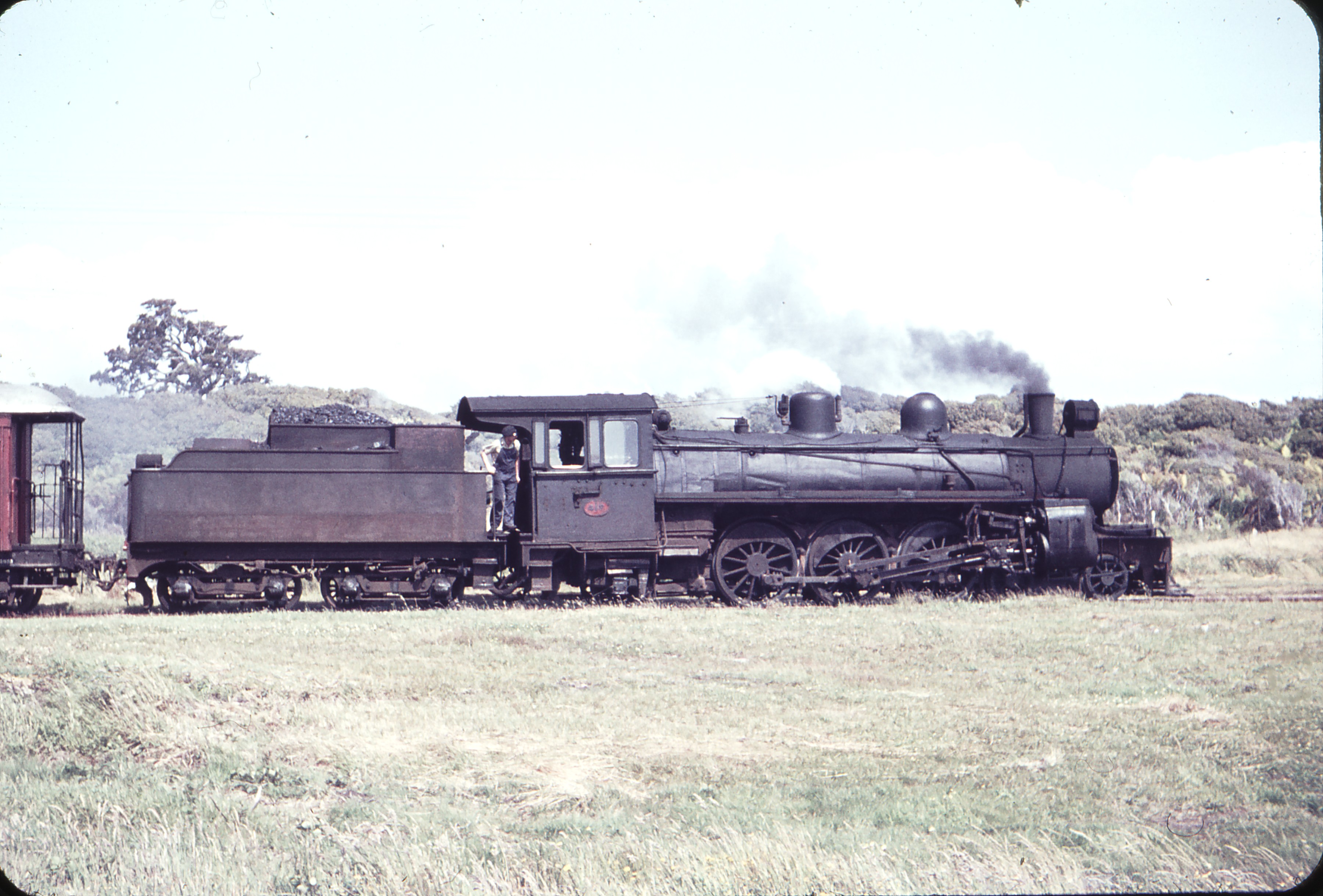
A Railway Enthusiasts Special hauled by A418 at Lake Mahinapua on 31 December 1963.
The loop has gone and the station has been replaced by a simpler shelter.
http://www.westonlangford.com/media/photos/103690.jpg
http://www.westonlangford.com/media/photos/103692.jpg


On the 10th of May 1965 Lake Mahinapua was closed as a station but remained open as a request stop for passengers. One of my earliest memories was going to a picnic at Lake Mahinapua taking the morning Ross-bound mixed goods from Hokitika to Lake Mahinapua and then walking into the lake and returning on the afternoon northbound railcar. 

On the 30th of June 1967 Lake Mahinapua station was closed to parcels and small lots of goods traffic but remained open for passengers only. Mixed trains ended on the West Coast on the 11th of September 1967 before all rail passenger services ended with the withdrawal of railcar services on the Ross line on the 9th of October 1972. 

Lake Mahinapua was finally closed to all traffic on the 30th of September 1973.


I have a feeling the original station burnt down??? Has anyone any details??? Please email me at westland831@gmail.com

Friday, 6 December 2013

Hou Hou

Ho Ho station opened with the opening of the Greymouth to Hokitika line on the 18th of December 1893.

Sidings were provided for traffic from Messrs J. C. Malfroy & Coy's sawmill at Ho Ho.

In 1901 the Railway Department decided to erect substantial stockyards at Ho Ho to accommodate cattle and sheep. A private siding right was granted to Messrs J. C. Malfroy & Coy's sawmill on the 1st of November 1904.

In November 1905 the West Coast Times reported that work was almost complete on Messrs J. C. Malfroy and Coy's private railway connecting the Ho Ho sawmills with their bush land on the north side of the Arahura River. The main line at that time was four miles in length and crossed the Arahura by a bridge of seven spans, sixty feet each, constructed of iron bark piers with heart, of red pine superstructure. The contractor for the bridge was Mr T. Dillon. A branch line 1½ miles in connection with Messrs Baxter Bros, at Kawaka was in the course of construction, and a second short branch line connected with Olderog's mill at Arahura. The railway was to bring the logs to the Ho Ho mill, and the sawn timber from Baxter and Olderog's to a Government siding at Arahura, where yards, sheds, etc. were to be established by the sawmillers interested. The engineers for the work were Messrs Gillies and Spence of Greymouth, and the principal contractors for different sections of the line, Havill and Gale, Hoffman and Co., Tracy and Co., Brown and Co. Pending the arrival of the locomotive, the completed portion of the railway was being worked by horses.

In November the following year the West Coast Times reported on an excursion on the Malfroy tram.

At the beginning of the week a party of about a dozen gentlemen, at the invitation of Messrs Malfroy and Company, visited their sawmill, and were entertained by an excursion over the Company's railway line. Mr J. C. Malfroy, senr, and his son, Mr C. Malfroy, are amongst the most progressive as well as leading sawmillers of the West Coast, and having decided that the old method of haulage of logs from the bush by means of horse power was out of date. They resolved to lay down a steel railway and substitute steam power. Another reason for so doing was on account) of the firm's large operations, the extensive catting going on at the mill requiring the haulage of logs a considerable distance.

A Payable Private Railway
To decide on these alterations and, improvements was with the Messrs Malfroy to have them executed to the shortest time possible, and a line of five miles of steel rails (25lb to the yard) 3ft 6in gauge has been laid down. This line is worked by a splendid little model of an engine of the four-wheeled coupled type, 8 tons weight, built to order specially for the particular work required by Barclay & Son, Kilmamock, Scotland. She is a powerful little engine, and draws over the line, which is well laid down, as many as seven pairs of bogies loaded with an average of 2500 superficial feet of timber each. It will readily be understood that the contrast of such haulage in time and labour saved and that of the old method of dragging logs on skids by horses, simply does not admit of comparison. The saving to Messrs Malfroy and Coy., by the improved method is a very material one, and the wisdom of the alteration is already fully justified.

The Excursion.
Favoured with excellent weather the outing along the firms line proved a delightful one. It was a gay company that cycled and drove to the mill at the Three Mile which was the rendezvous, the air crisp and invigorating, and everyone bent on enjoyment. There stood the pretty little engine drawing an extemporised open car, the seats built on a couple of pairs of bogies, which proved a very comfortable vehicle to ride on. Everyone had a box seat, the Irish jaunting car principle having been adopted in construction and in the boot (if such a vehicle can have a boot) the hampers were stowed, which later on proved very acceptable. The whistle blows, the gallant little engine, making light of her freight of excursionists after her customary heavy work, sets off at a good speed, and we are whisked into the bush. On through avenues of tall and stately bush, through ferney glades, the vista constantly changing with delightful variety. Now we are on a long stretch of very straight line that seems to extend indefinitely, and our iron steed makes great pace. Next through a cutting, passing a fairly steep drop into the valley below, which shows some little engineering difficulties were overcome in the construction of the line. And then after perhaps an hour's travelling a halt is called for lunch in a shaded retreat. What a merry meal that was, the "shadow catchers" of the party distinguishing themselves by their efforts to fix the scene permanently. All are disposed for fun and festivity, and the oldest members of the party play the merriest jokes. This hour, and indeed every hour of the outing, will be held in most pleasant remembrance. Time passes, however, and once more at the call of the honorary guard, the passengers are mounted on the jaunting car. We cross the handsome and substantial bridge erected by Messrs Malfroy froy and Company over the Arahara river, and pass the picturesque and flourishing farms owned by Mrs H. Bradley and Mr D. Bradley, getting glimpse of the Arahura river running through the verdant looking pastures. Onward then, through the line to Messrs Baxter Bros' mill, which is our destination. The journey home is varied by a stoppage for afternoon tea, when excursions into the bush are made, and the "snap shooter"' again gets to work. We arrive back shortly before 5 p.m., after as delightful a picnic as could be imagined carried out under unique and most interesting conditions. Needless to say, all present thoroughly enjoyed themselves and greatly appreciated the hospitality and courtesy of Mr J. C. Malfroy senr., and his sons.

On the 1st of November 1944 the name of the station was changed from Ho Ho to Hou Hou.

Timber from Malfroy and Coy., later taken over by the Westland Box Coy. Ltd’s and Process Timber’s sawmill was the mainstay of traffic from the Hou Hou station. Both companies operated a variety of bush tram locomotives on the tram. The last of these, a Planet diesel tractor was sold to the Hokitika Dairy Factory in September 1968. The Planet was run along the NZR line to Hokitika.

Passenger services to Hou Hou ceased on the 9th of October 1972 when the railcar service to Hokitika and Ross was withdrawn.

By November 1974 the Railways Department had announced proposals to pull down the Hou Hou station. The Minister of Railways, Mr Bailey, said that little use now made of the station and it does not warrant the continued maintenance of the building. “It is accordingly proposed to close Hou Hou to all traffic except for goods in wagon lots and to dispose of the station building and platform. The majority of freight handled at Hou Hou is for the sawmills in the area and a poultry farm. None of these clients should be adversely affected by the removal of the station and platform.”

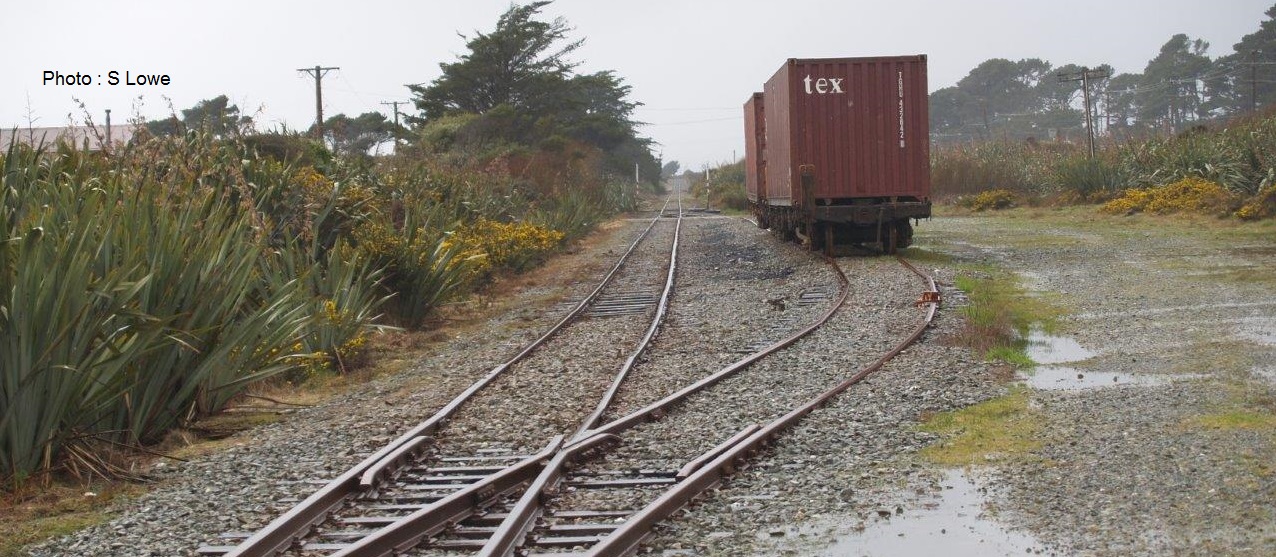
Hou Hou station was closed to all traffic except goods in wagon lots from the 6th of July 1975. At some point around this time the south end points were removed.

In 1998 the main traffic from Hou Hou was sphagnum moss in container wagons from the adjacent sphagnum moss factory. In 1998 sawn timber in open wagons and log traffic was observed being shipped from Hou Hou.  By 2000 the southern end points were reinstated.


The Hou Hou yards in 2006 looking north (above) and below looking south  (below)


In August 2008 work commenced on the replacement of the Hou Hou Creek bridge. Ontrack’s engineer manager Walter Rushbrook told the West Coast Times that the 40 metre bridge had reached the stage where it needed to be replaced. The wooden piles and timber beams would be replaced with steel piles and spans at a cost of about $500,000.


Dbr 1213 crosses the old Hou Hou Creek bridge on 11 September 2006

Reconstruction of the Hou Hou Creek bridge.


Dc4751 crosses the rebuilt Hou Hou Creek Bridge on 17 December 2009

In 2011 the bridge over the Little Hou Hou Creek was replaced with a single span concrete and steel bridge as the Hokitika Industrial Line was upgraded from a maximum axle load of 14.3 tonnes to 16.3 tonnes.


The new bridge over Little Hou Hou Creek on 9 October 2011


Papakamai

Papakamai station was situated 36 miles 4 chains from Greymouth and was opened for traffic on the 1st of April 1909, when the Hokitika to Ross section was opened. The station had a loop siding, capable of holding 20 wagons, as well as an accommodation shelter shed. The siding was connected to bush tramway. 

New Zealand Map Series NZMS13, 1919. Papakamai is located when Papakamai Road joins the railway.


Grey River Argus, 1 April 1909

The Wises Directory of 1912 described Papakamai as a railway siding 12 miles from Hokitika and 3 miles from Ross.

In February 1931 it was recorded that, “During the last twelve months no passengers have been booked from Papakamai and there has been no parcels traffic to or from that station. The mill tram track, which was the only access to this stopping place, is overgrown with second growth and there is now no access to rail at this point. The siding was provided to serve a timber mill working in the locality, but this ceased operation some years ago and there are no houses in the vicinity.”


Papakamai flag station was closed on the 19th of September 1931

Saturday, 3 August 2013

Seaview

Seaview station was located two kilometres north of Hokitika. The station facilities included a small shelter and platform with a loop siding on the western side of the main line with a sheep and cattle yard and loading facilities for the adjacent abattoir. This was the main traffic. The station was often used for visitors and staff going to Westland Hospital and Seaview Psychiatric hospitals. I have read (somewhere) that many years ago patients being transferred to Seaview Hospital were often accommodated in the guards van and they were met by hospital staff at Seaview station. In latter years, before the days of couriers, a satchel carrying hospital mail, samples and test results, was carried on the goods trains between the Hokitika hospitals and Greymouth Hospital. The satchel was picked up or dropped off at Seaview and Wharemoa which is adjacent to Greymouth Hospital.

29 Jan 1908 - Accident to the Hokitika-Grey Train -
Horse Run Over and Cut to Pieces - A Carriage Derailed
An accident which might easily have had more serious consequences occurred to the 8.35 outward train last evening. The train left Hokitika for Greymouth as usual, with eight passengers aboard, and when approaching Seaview station the engine ran into a horse (subsequently found to have been owned by Mr Charles Hannam, butcher), literally cutting the animal to pieces, The engine and the first carriage passed over the carcase, but the axles of the next carriage broke and the vehicle became derailed. As soon as a stoppage was come to the engine and first carriage were unhitched from the rest of the train and continued the journey to Kumara to bring back the Christchurch passengers as far as the scene of the accident. Dowell's coaches were sent out to meet them and brought the incoming passengers on to town. The accident caused fully a couple of hours delay and it was nearly midnight before the passengers by the incoming train reached Hokitika. The accident caused some damage to the line, which the derailed carriage also continued to block. A gang of linemen were, however, sent out to clear away the obstruction and effect temporary repairs to the broken down carriage, so that it with the rest of the train could be brought to Hokitika, also to put the line in order again. It was expected that this work would be completed during the night so that the line would be quite clear again for the running of the train this morning.


An A class locomotive heads the afternoon goods to Greymouth through Seaview on 24 May 1960. The loop and stock yards can be seem along with track maintenance equipment. Photo : Archives New Zealand
  
4 Aug 1977 - Seaview Rail Station to be Closed
The MP for West Coast, Mr P Blanchfield, has been advised of a proposal to close the Seaview railway station to all traffic except goods in wagon lots. The Minister of Railways, Mr C McLachlan, said in a letter to Mr Blanchfield the station was very little used now for parcels and small lots of goods traffic. He said the closure would entail removal of the station building and platform but all other facilities would still remain intact. The proposal has not been put before any interested parties but when it has, Mr McLachlan said he would advise Mr Blanchfield of the outcome.
 
Source : Greymouth Evening Star

 
22 Oct 1977
Seaview station was closed to all traffic except goods in wagon lots.

 
31 Jan 1982
Seaview station was closed to all traffic.

By 1998 the siding at Seaview had long gone. However the train still stopped to service the sphagnum moss factory that took over the old abattoir. A forklift from the Hokitika freight terminal would go out to the factory to meet the train. On 4 September 1998 an empty container was being off loaded the south-bound Number 6 Shunt at Seaview. Once completed the train rolls on to Hokitika while the forklift drove back into town. The same process was followed with full containers being uplifted by the northbound shunt.


Dc 4421 with a southbound Number 6 Shunt between Seaview and Hou-Hou on 24 February 2003

A short number 6 shunt hauled by Dsc 2693 trundles just north of Seaview heading towards Greymouth on 14 July 2003

Doing spot welding north of Seaview on 5 September 2005


Wednesday, 31 July 2013

Keith Road

A new railcar stopping place between Greymouth and Hokitika, on the Ross line was opened for traffic in the middle of February 1965. Situated between South Beach and Paroa, the new station has been named Keith Road. As the new station is near bridge No. 8, marker posts have been installed on the platform to indicate to drivers of double unit railcars when the cars are clear of the bridge. All railcar services operating between Greymouth and Ross and return now stop at Keith Road to pick up or set down passengers.
 
Source : The Express, Vol 2, No 7
 
By 1998 the railcars had long gone. Here Evaluation Car Em 80 operating as train XR-7 approaches what was the Keith Rd railcar stop on 1 October 1998. The platform is to the left of the Evaluation Car. 

Tuesday, 28 May 2013

Hokitika

 
25 May 1893 - Opening of Hokitika Grey Railway
This event, which bad been looked forward to with eager anticipation for so long, took place yesterday. As is usual in functions of this description, the state of the weather constituted an important element in the success or non-success of the demonstration. Tuesday was fine but the clouds closed in ominously as night came on and several heavy showers fell. The morning, broke gloomy and threatening and when the train came in from Greymouth to convey the first excursion there seemed every probability of its raining. The Hon the Premier drove in from Kumara early in the morning and went through to Greymouth by the first train. Owing to the threatening state of the weather a number of intending excursionsists decided to remain in town and a great number of country settlers delayed coming into town till later in the day. Still, the first train took fully a thousand passengers, all parts of the district being represented, miners from the neighbouring gold fields, farmers from Arahura and Kokatahi and settlers from South Westland, besides a respectable percentage of Hokitika residents. Contingents were taken in at the Arahura bridge, Stafford track, Kumara road and at Paroa, so when the train arrived at Greymouth it presented an imposing spectacle. The greatest enthusiasm prevailed throughout. At every habitation, road, or track abutting on the line could be seen men, women and children waving hats, handkerchiefs, ferns, in fact anything handy that enabled them to express their satisfaction at the occasion, whilst when ever the train slowed down the band added their tribute. At Greymouth flags were flying in all directions and the streets were alive with people. In addition to the Hokitika train, the Midland Company sent one down from Reefton and the Grey Valley which contained from four to five hundred people whilst the tugboat Westland had brought 40 down from Westport. A hundred had got on board but the Collector of Customs refused to allow more than 40 to travel being the number for whom a special permit had been obtained. The members of the local bodies insisted on their right to come and a number of residents made up the contingent allowed,
Luncheon at Greymouth.
At half-past eleven a public luncheon took place in the Public Hall. Seats had been laid for 150 persons and every space was occupied. The chair was occupied by the Mayor of Greymouth (Mr Kettle) having the Hon the Premier on his right hand and the Mayor of Hokitika on his left hand. The vice chairs were occupied by Mr Hannan (Gray County Chairman) and Mr Matheson. Amongst the guests were Mr Hales (Engineer-in-chief) and Maxwell (Railway Commissioner) the Mayors of Westport, Brunnerton, Kumara and Ross and the Chairmen of the County Councils of Buller and Inangahua. The luncheon baying been disposed of the Chairman gave the toast of the Queen which was drank with more than usual enthusiasm, those present recognising the fitness of the occasion. The Chairman said before proposing the next toast he would read some telegrams he had received, one from Mr R. H. J. Reeves regretting his inability to be present and one also from the Hon Sir P. A. Buckley to a similar effect. He also read a telegram from Hons Cadman, Buckley and Ward sending their congratulations, on behalf of the Cabinet, on such an auspicious event and expressing a hope for the prosperity of the two towns. He would now ask them to drink 'Success to Hokitika-Grey railway' and would couple the toast with the Hon the Premier to whom they were indebted for the completion of the line. Time did not permit of very much being said but he was sure they would oil agree with him that the line would be of the greatest good to both places. The Hon Mr Seddon, who was received with cheers, said the time when Greymouth and Hokitika were separate communities had passed away for ever. They were now united by a steel link which would last for all time. In 1879 the construction of the line was commenced, a section being first contracted for in Greymouth which always seemed to get a little ahead of the sister town. At that time a Liberal Government was in power under Sir George Grey, a Government that in addition to other good works bridged the rivers on the Coast. Then came a change and the Hall, Whitaker and Atkinson Ministry came into power. Following that was a feeling on the part of their southern neighbours that it would be better to have a harbour constructed, and the money was spent on harbour works. The Grey Government spent £16,000 on the line, and the next Liberal administration, the Stout-Vogel Government, expended another £32,000. Things were then allowed to remain in the same condition though at length the Atkinson Government was induced to spend £14,000 on the section at the Teremakau. This was the first recognition an Atkinson Government had extended to the line. Then the Ballance Government came into office and in referring to his late honoured chief he might mention that Mr Ballance had intended to be present at the opening of the line but the ways of Providence were inscrutable and this was denied to them. Still the Ministry remained for it was really the same Ministry and he was now with them as Prime Minister. He could say that in his most sanguine moments he had never hoped that the Premier would come from the West Coast or that be would be honoured with such a position. At the same time he felt satisfied that if the West Coast had supplied one or two more premiers the country would have suffered no harm. When the present Liberal party came into office they found £100,090 had been spent, all of which was producing nothing whist culverts and bridges were rotting and rails rusting. They regarded it as a partially completed line which required the expenditure of another £75,000 to make the £100,000 reproductive and he claimed that the money was being well spent. He referred to the assistance he had received from his fellow members) first of all Mr Reid, then Mr Bevan and he had worked shoulder to shoulder. Mr Bevan bad always opposed expenditure on the harbour as against the railway. Mr Grimmond had also worked with him and Mr Guinness, their present member had always worked most harmoniously with him, in fact the Coast representatives had always been very united in their actions. Some croakers had said that the line would not pay for axle grease but they seemed not to know that there were 9000 people living south of the New River who would supply plenty of traffic. They had a promise of the support from the number of people travelling that day and to provide arrangements they had the assistance of one of the Railway Commissioners, Mr Maxwell, whom be desired personally to thank for coming, Mr Hales, Engineer-in-Chief, Mr Rawson, Resident Engineer, the assistant engineer and the staff of public works and railway officials. He had been blamed for keeping back the railway for the deviation but they must now agree with him that the railway was in the right place. By taking it to the top of the terrace on horse could draw as heavy a load to Kumara as would require four from the beach. The line was now completed and instead of a journey between the two places and back occupying 2 or 3 days and costing about £3 it could now be done in an hour and half. The cost of the line was £7200 per mile whilst the average for the colony was £7800. The line from Hokitika to Brunnerton would cost £250,000 whilst the 1860 miles in the colony cost 14¾ millions; with such a large expenditure they had no right to grudge the two districts this line. He desired, on behalf of the Government, to tender their thanks to their officers for the manner in which the work had been carried out. A great deal of it had been done under the co-operative system and though the wording of that system might cause some slight friction, these small differences are soon forgotten. Ac soon as the stations are completed they would hand over to the Railway Commissioners. He was glad Mr Maxwell was present at the opening and trusted the doubts that previously existed in his mind respecting this line would disappear. He heartily thanked them for the reception of himself and their expressions of approval of the Ministry. A Government could only be a Government so long as it retained the confidence of the people and it would be their aim to retain that confidence (cheers). Mr Seddon then proposed the toast of the Mayors and County Chairmen which was duly honoured and responded to. Mr John Bevan proposed "Railway Construction and Maintenance" coupled with the names of Mr Maxwell and Mr Hales. In doing so he dwelt upon the great benefits to be derived from the line and mentioned that when in Dunedin Sir Harry Atkinson admitted to him that one of the saddest sights he had seen on his recent visit to the Coast was the evidence of a large expenditure on works which were lying unutilised and going to ruin and he expressed his determination to have the line completed as soon as he possibly could. Had he known the true position he would have had it constructed years ago. Mr Maxwell said he was deeply gratified at being present. The Hon the Premier had thanked him for coming but he had to thank the Premier for affording him the opportunity of being present. For 19 years he had been connected with the railways and had witnessed many openings but none which were so gratifying. He was surprised at the district and confessed he had not expected such magnificent support. He trusted when the management of the railway was placed in the hands of the Commissioners it would be found they had a due regard for the responsibilities placed upon them and he understood that one of the greatest of these responsibilities was to endeavour to foster and assist the industries of the country. Mr Hales also responded. Mr Guinness proposed the toast of the Press which was duly honoured and those present dispersed to seek seats in the return train.
The Opening Ceremony.
To provide for the large number of excursionists from the north as well as those returning to Hokitika an extra train was put on which left a quarter of an hour afterwards fully 3000 persons being on board the two trains. The run down was made in the same time as the up journey - two hours - and was attend by similar demonstrations of good will on the part of the spectators along the line to which those on the trains responded with vigour. On coming into Hokitika the triumphal arch erected across the line at the corner of Weld and Fitzherbert streets excited general admiration whilst the tasteful decorations at the entrance of the police enclosure and other adornments in different places came in for their measure of praise. The crowds of people, the plentiful display of bunting, and the abundance of ornamental trees all combined to form a very attractive spectacle. The engine and carriages having passed under the arch and broken the silken ribbon stretched, across the line, the train was soon brought to a standstill and the Hon the Premier with Mrs Seddon and other ladies, the Mayor, visitors, and a number of influential residents ascended the platform when the Mayor called for cheers for Mr Seddon, which were given with much enthusiasm, Mrs Seddon also being heartily cheered. The Mayor read a telegram from Sir Patrick Buckley, regretting his inability to be present and also from the Cabinet to the Premier congratulating him upon the completion. He briefly referred to the benefit the district and especially the Arahura and Kokatahi farmers would derive from the opening of the line and asked the Premier to address the gathering. The Premier said he felt proud and glad to be present on that occasion, The last time he addressed them in the open air was at the last election and he little thought then that in so short a time he would be addressing them as Premier of the colony. Since ascending the platform he had received a telegram from Mrs Ballance and that had again brought to memory how much they all had lost by the death of their late Premier. He paid a passing tribute to the gathering before him and referred in feeling terms to the old pioneers of the Coast and hoped the young men would be worthy children of worthy parents. The isolation under which they had existed for so long had been broken down by the band of steel which row united them to the north. He referred to the expenditure which had been made from time to time and spoke of the expenditure on the harbour which had proved such a failure. Why it was the failure it proved was not for him to say, whether the fault of amateur engineers or any other cause; he could at least safely assert that enough moneys had been spent on the Hokitika river from the early days to the present time to build the railway. The isolation in the past had proved injurious to the place in many ways. The expenditure of Hokitika money in the early days had made Reefton, but it had never benefited by that expenditure owing to its isolation. That drawback had now been removed and tourists would be coming here to see the beautiful lakes and other scenery of the district. Besides the ranges being objects of beauty they possessed vast mineral wealth which some time would make this one of the most prosperous districts in New Zealand. Discoveries had recently been made, information of which was now in the hands of the Government which left no doubt as to the accuracy of this prediction. In the near future they could expect rapid development of the timber trade and he believed that before long there would be several sawmills between this place and Greymouth. Government had recently made enquiries and found that West Coast timber could be landed at 2s per 100 feet less than at Wellington, Lyttelton or Dunedin. He thanked them most heartily for their reception of himself and for their cheers for Mrs Seddon; she had been a true and loyal helpmate to him and but for her he would never have been Premier. He could perhaps go further and say he doubted if those before him really understood all they owed to their wives. Once more he thanked them. Mrs Seddon then broke a bottle of champagne on the rails and declared the line open an announcement which was received with renewed cheering. Mr Mandl, as chairman of the Railway League, desired to express his thanks to the Hon Mr Seddon for what he had done in getting the line constructed. He said if the Railway Commissioners adhered to the schedule the line would not pay but if they competed with the steamers it would be one of the best paying lines in New Zealand. Mr Daly, County Chairman, also thanked Mr Seddon on behalf of the inhabitants of Westland for his exertions. The gathering then dispersed, some going to the Town Hall, to which place the Borough Council had invited a few residents, and some of the visitors. The two return trains left in the evening, one at 5 and one at 5.30, and a special train was sent through at 10 p.m. This concluded what may be called a red letter day in the annals of this district.
Source : West Coast Times

15 Dec 1893 - Hokitika Crossing Accident
 
A very serious accident occurred on the railway line yesterday at 2 o’clock at the Park Street crossing.  Mr C Rugg was driving his four horse coach to Kumara and had got half way across the line when the train coming into town and proceeded by two trucks struck his vehicle.  The effect was marvellous.  The coach was shattered to pieces some of the fragments being carried several yards away.  A portion of the loading bounded into the air from the shock and fell into the truck and Mr Rugg with it.  Only one of the horses was injured and that not seriously, at least at present it is not supposed the injuries will prove of a serious nature.  The leaders galloped down Park Street and were eventually secured, whilst the pole horses were led away.  Grave fears were entertained as to Mr Rugg’s condition but when the train was stopped he seemed to have escaped unhurt though naturally a good deal shaken.  The escape is little short of the miraculous, had there not been a truck in front on the engine the probability is that he would have been killed.  Mr Lindemann, the driver of the engine, says that he kept sounding the whistle as he came along and this statement is corroborated by persons in the locality.  Mr Rugg says he never heard the whistle.  In any case the Park Street crossing is a dangerous one.  It is almost impossible to see if a train is coming until the horses are abreast of it and it is necessary to have some little speed on in order to surmount the rise on the other side.  In all probability vehicles going north or coming from that locality will in future choose the Hampden Street crossing.
Source : West Coast Times


10 May 1894 - New Railway Station

Messrs Thomson (Resident Engineer) and Mclntosh (Railway manager) were down on Monday and inspected the new Railway Station, which is out of the contractors hands and has now been taken over by the railway authorities; it was formerly taken possession of by Mr Falla, stationmaster, yesterday afternoon. The building has a frontage to a platform 250 ft in length, also to a new street formed at the back, of 87 feet — and is divided in rooms and offices. In the centre is a spacious hall 20ft by 20ft, in which is the ticket office 10ft by 10ft, partitioned off by a handsome panel frontage consisting of silver pine and beautifully polished rimu. On the southern side of the hall is the Stationmaster's office 15ft by 10ft, parcels office 15ft by 10ft, ticket office 10ft by 10, and a lamp and store room 12ft by 10ft. The eastern portion consists of the gentlemen's waiting-room 20ft by 13ft, entered from the hall. The ladies waiting-room, also 20ft by 13ft, has an entrance from the platform. Leading from this room there is a roomy lavatory with water laid on and other conveniences. The ceilings throughout are lofty (13ft 6in), and well ventilated and lighted by gas and three branch gas chandeliers. By two substantial brick chimneys of 4ft foundation, 26ft in height, all rooms and offices are supplied with fireplaces. A verandah extends the whole length of the building and to the outer edge of platform, (16ft), and is well supported by silver-pine posts and iron brackets. The lining of this, (an addition to original intentions) is a great improvement on the bare rafters and roofing, and finishes off a substantial and faithfully built structure. The .work has been done en co-operative contract and reflects great credit on Messrs J. C. Malfroy who supplied the timber, and Messrs Boyd, Debenham, Williams, Goodrick, Gooch and Fowler, for the carpentering. Messrs Ross Bros, were manufacturers of all doors, window frames, sashes, etc., which were turned out in an excellent manner. Painting and varnishing forms no small part of the work, which in the hands of Messrs J. Holmes, together with the lettering of Mr H. Holmes has been carefully executed in a workmanlike manner. The plumbing work by Mr Amberger, and gas-fitting by Mr Chamberlain have also been equally well performed. Messrs Johnston & Co in supplying the material in ironmongery, gas-fittings, have supplied genuine value in all respects. The Department are indebted to Mr George Cooke, local architect, and Mr Edmund Wickes, overseer, for the interest, energy, and attention to the fulfilment of a thoroughly substantial completion. When surrounding conveniences (which are about to be taken in hand) are completed, Hokitika station will be a creditable addition to the town. An engine shed, 70 by 25, with two concrete pits has recently been completed by Messrs Gibson & Co., and Pengelly & Co, constructed in a like satisfactory manner. The goods shed, 60 by 40, which has been in use some months has been frequently taxed for room, — and altogether the revenue has exceeded anticipations; with one new sawmill and others likely to be erected we may expect a fairly remunerative traffic.
Source : West Coast Times


A lot has changed since this photo of Dsc 2693 was taken with a short Number 6 shunt on 14 July 2003. Nowadays the shunt does not operate during the dairy off-season, the freight terminal has gone, as is the all other non-dairy freight traffic from Hokitika
Dbr1213 pushes its load of empty wagons across SH 6 and down to the dairy factory on 11 September 2006
Muscle-power - Dc4542 Dxc5431 enjoying the Hokitika sunshine on 17 April 2012  
 Dc4876 and Dxc5419 pull away from the dairy factory on 9 April 2013

A gloomy and wet day - Dc4876 and Dxc5419 cross the Tudor Street Crossing on the way to Greymouth on the 24th of May 2013...